Table of Contents
- Quartz vs. Granite Countertops: Quick Comparison
- What Is the Difference Between Quartz and Granite Countertops?
- Is Quartz Better Than Granite?
- Is Granite Better Than Quartz?
- Quartz Countertops: Pros and Considerations
- Granite Countertops: Pros and Considerations
- Is Quartz Cheaper Than Granite?
- Quartz vs. Granite Kitchen Countertops
- Quartz vs. Granite Bathroom Countertops
- Quartz vs. Granite: Maintenance and Cleaning
- Quartz vs. Granite: Appearance and Design
- Quartzite vs. Granite: Are They the Same?
- Best Uses for Quartz vs. Granite Countertops
- What Should You Compare in Person Before Choosing Quartz or Granite?
- Should You Choose Quartz or Granite Countertops?
- How Countertop Choice Affects Sinks and Faucets
- Where Can You Compare Sinks and Faucets for Quartz or Granite Countertops?
- Quartz vs. Granite Countertops FAQs
Quartz and granite are two of the most popular countertop materials for kitchen and bathroom remodels. Both can create a high-end finished look, but they are very different in how they are made, how they look, how they perform, and how much maintenance they require.
Quartz countertops are engineered surfaces made for consistency, stain resistance, and easier upkeep. Granite countertops are natural stone surfaces known for unique slab movement, mineral variation, and strong heat resistance.
Homeowners often compare granite vs. quartz countertops because both materials can create a premium look, but they differ in maintenance, appearance, heat resistance, and design flexibility.
The better surface comes down to how you use the room, how much maintenance you want, and what kind of design statement you want the countertop to make. It also affects the rest of the remodel. Your countertop choice can influence the sink style, faucet height, faucet finish, backsplash, cabinet hardware, and overall fixture package.
Because countertops sit directly next to the sink and faucet, this decision can shape more than the look of the room. It can affect sink mounting, faucet clearance, finish balance, backsplash choices, and how the completed kitchen or bath functions every day.
At Banner Plumbing’s Buffalo Grove kitchen and bath showroom, homeowners, designers, builders, plumbers, and contractors can compare sinks, faucets, and fixture finishes in person once they have a countertop direction in mind. This helps the completed kitchen or bathroom feel coordinated instead of pieced together.
Planning a remodel? Once you narrow the countertop direction, the sink and faucet decisions become much easier to get right in person. Faucet height, sink mounting style, finish tone, and fixture scale can all look different depending on whether the surface is quartz or granite. Visit Banner Plumbing’s Buffalo Grove kitchen and bath showroom for guidance, or get directions to the showroom.
Quartz vs. Granite Countertops: Quick Comparison
| Category | Quartz | Granite |
|---|---|---|
| Material Type | Engineered stone | Natural stone |
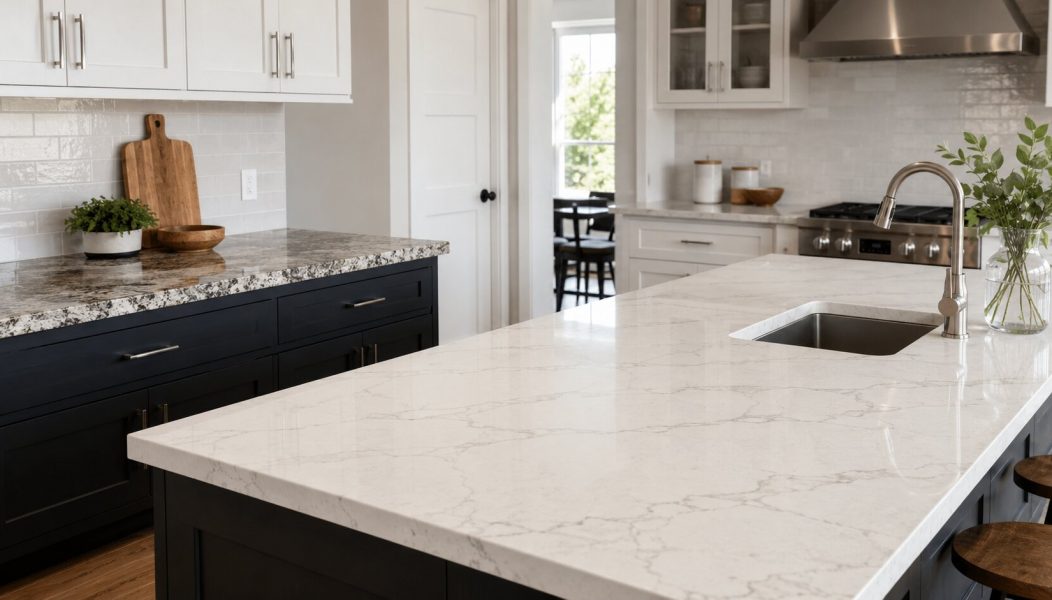
| Appearance | More consistent colors and patterns | Unique natural movement and variation |
| Maintenance | Low maintenance and does not need sealing | Needs periodic sealing |
| Stain Resistance | Nonporous and highly stain resistant | More stain-prone if not properly sealed |
| Heat Resistance | Heat resistant, but direct hot pans can damage the resin | More naturally heat resistant |
| Design Fit | Good for clean, modern, and consistent designs | Good for natural, traditional, and one-of-a-kind designs |
| Best For | Busy kitchens, bathrooms, and low-maintenance remodels | Homeowners who want natural stone character and unique slabs |
What Is the Difference Between Quartz and Granite Countertops?
The main difference between quartz and granite countertops is that quartz is an engineered surface, while granite is natural stone. Quartz countertops are made with ground quartz, resins, pigments, and binders. Granite countertops are cut from quarried stone slabs.
Because quartz is engineered, it usually has a more consistent appearance from slab to slab. That makes it easier to plan around a specific color, pattern, or design direction. Quartz is also nonporous, which makes it easier to maintain and more resistant to staining.
Granite has more natural variation. Each slab has its own movement, veining, mineral pattern, and color depth. That makes granite appealing for homeowners who want a countertop that feels more organic and one of a kind.
Both quartz and granite countertops can perform well in kitchens and bathrooms. The better surface comes down to whether you value consistency and low maintenance or natural stone character and variation.
Is Quartz Better Than Granite?
Quartz may be better than granite if you want a low-maintenance countertop with consistent color, pattern, and stain resistance. Quartz is often the practical match for busy kitchens, bathroom vanities, and remodels where easy cleaning is a priority.
Because quartz does not need to be sealed, it can be easier to live with over time. It also offers more predictable design options, which can be helpful when coordinating countertops with cabinets, backsplash tile, sinks, faucets, and hardware.
Granite may still be the better choice if you prefer natural stone movement, unique slab variation, and stronger heat resistance. The decision depends on how you want the countertop to perform and how much natural variation you want in the completed kitchen or bath.
Is Granite Better Than Quartz?
Granite may be better than quartz if you want a natural stone countertop with unique patterning, mineral variation, and strong heat resistance. Every granite slab is different, which gives the finished countertop a more natural and custom look.
Granite can be especially appealing in kitchens where the countertop is meant to be a major design feature. A dramatic granite slab can add depth, movement, and character that engineered surfaces may not fully replicate.
Quartz may be better if you want a more consistent appearance and lower maintenance. Granite can be durable and long-lasting, but it usually needs periodic sealing to help protect against staining.
Quartz Countertops: Pros and Considerations
Engineered quartz countertops are often selected by homeowners who want durability, consistency, and easy maintenance. Because quartz is engineered, it is available in many colors and patterns, including styles that resemble marble, concrete, or natural stone.
Quartz Pros
- Low-maintenance countertop option
- Nonporous and highly stain resistant
- Does not require sealing
- More consistent color and pattern than granite
- Good fit for modern kitchens and bathrooms
- Useful when coordinating with specific cabinet, backsplash, sink, and faucet finishes
Quartz Considerations
- Can be damaged by direct high heat
- May not have the same natural variation as granite
- Some patterns can look more uniform or engineered
- Edges, seams, and fabrication details still affect the final appearance
- Not always cheaper than granite
Quartz is often a practical choice for busy households. It pairs well with remodels where the countertop needs to look polished, clean easily, and support a predictable design direction.
Granite Countertops: Pros and Considerations
Granite countertops are natural stone surfaces known for their unique appearance and long-term durability. Each slab has its own pattern, which can make granite a design match for homeowners who want a surface that feels natural and distinctive.
Granite Pros
- Natural stone with one-of-a-kind slab variation
- Strong heat resistance compared to quartz
- Durable surface when properly maintained
- Good fit for traditional, natural, and custom kitchen designs
- Can create a strong design feature on islands and vanities
- Wide range of colors, patterns, and mineral movement
Granite Considerations
- Usually requires periodic sealing
- More porous than quartz
- Can stain if not sealed or maintained properly
- Slab variation can make design matching more complex
- May require more in-person selection than quartz
Granite is often most appealing when the countertop is meant to be a natural focal point. It can give a kitchen or bathroom depth and character, but it requires more maintenance planning than quartz.
Is Quartz Cheaper Than Granite?
Quartz is not always cheaper than granite, and quartz and granite countertop costs often overlap. Final pricing depends on the specific material, slab quality, brand, rarity, fabrication, edge detail, installation complexity, and local labor.
Some granite slabs may be more affordable than quartz. Some quartz products may be more affordable than premium granite. The final cost also depends on project details such as countertop size, cutouts, seams, sink installation, edge profile, backsplash, and any special fabrication needs.
Cost can also change based on whether the project includes an undermount sink cutout, waterfall edge, island overhang, backsplash material, specialty edge profile, or multiple countertop seams.
For kitchen remodels, countertops can be a major budget variable. If you are planning a larger project, first estimating the cost and your budget for your kitchen remodel can help you think through how countertop selections fit into the broader renovation budget.
Quartz vs. Granite Kitchen Countertops
Quartz vs. granite kitchen countertops should be compared based on how the kitchen will be used every day. A countertop may need to handle cooking, cleaning, meal prep, spills, small appliances, hot pans, and frequent sink use.
Quartz kitchen countertops are often a practical match for busy kitchens because they are nonporous, low maintenance, and easy to clean. They also provide a consistent design backdrop, which can be helpful when coordinating cabinets, backsplash tile, sinks, faucets, and cabinet hardware.
Granite kitchen countertops are often the better design match when the countertop is intended to bring natural character into the room. A granite island or perimeter countertop can become a visual feature because of the stone’s movement, color depth, and variation.
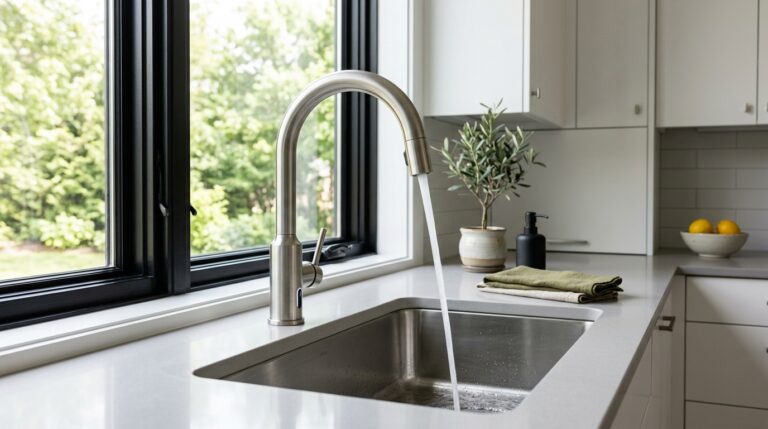
For kitchens, the countertop decision should also be made alongside the sink and faucet plan. A large undermount sink, workstation sink, pull-down faucet, pot filler, or statement fixture may look and function differently depending on the countertop material, thickness, color, and visual weight.
Quartz vs. Granite Bathroom Countertops
Quartz vs. granite bathroom countertops should be compared based on maintenance, water exposure, vanity style, and how much visual impact the surface needs to create.
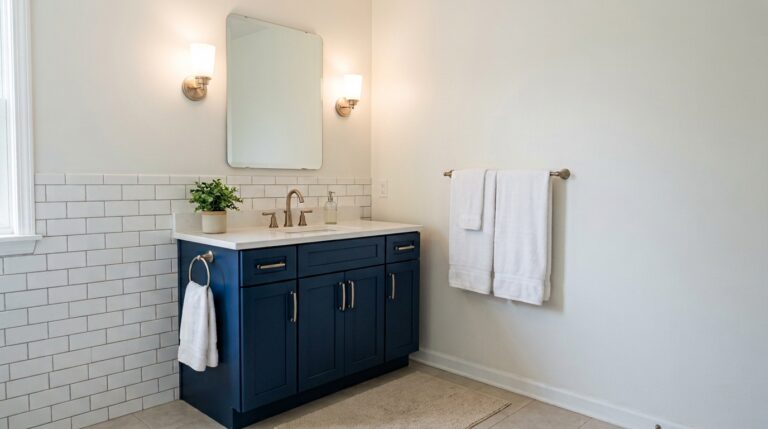
Quartz can be a practical bathroom vanity material because it is nonporous and easy to clean. It can work well in primary bathrooms, guest bathrooms, powder rooms, and children’s bathrooms where water, soap, toothpaste, cosmetics, and daily use are common.
Granite can work well in bathrooms where the vanity is meant to feel more natural or custom. A granite vanity top may add character to a powder room or primary bathroom, especially when paired with the right sink shape, faucet finish, mirror, and lighting.
In bathrooms, countertop material should also be coordinated with sink style and faucet placement. Undermount sinks, vessel sinks, widespread faucets, wall-mounted faucets, and single-hole faucets all interact differently with the countertop surface.
Quartz vs. Granite: Maintenance and Cleaning
Quartz is usually easier to maintain than granite because it is nonporous and does not need sealing. Quartz countertops can typically be cleaned with mild soap, water, and a soft cloth.
Granite requires more maintenance because it is porous. To help protect against stains, granite countertops usually need to be sealed periodically. The exact sealing schedule depends on the stone, use, and sealer type.
For both materials, it is best to avoid harsh cleaners, abrasive pads, and unnecessary surface damage. Quartz should be protected from direct high heat with trivets or hot pads. Granite is more heat resistant, but using protection is still a smart habit to preserve the surface over time.
Quartz vs. Granite: Appearance and Design
Quartz offers more control and consistency in countertop design, while granite offers more natural variation and one-of-a-kind slab movement.
Quartz countertops are often chosen when the homeowner wants a clean, consistent look. They can pair well with modern kitchens, transitional bathrooms, and remodels where a predictable color palette is important. Quartz can also imitate marble or other stone looks while offering easier maintenance than some natural materials.
Granite countertops are often chosen when the homeowner wants the surface to feel natural, textured, and unique. Granite slabs can include dramatic movement, subtle mineral flecks, deep color variation, or earthy tones that create a more organic look.
Before finalizing either material, it is important to view samples or slabs in person when possible. A countertop can look different depending on lighting, cabinet color, backsplash material, sink finish, faucet finish, and surrounding fixtures.
Quartzite vs. Granite: Are They the Same?
Quartzite and granite are not the same. Both are natural stone materials, but they come from different geological processes and have different appearances.
Quartzite is a natural stone that begins as sandstone and changes under heat and pressure. Granite is an igneous stone made from minerals such as quartz, feldspar, and mica. Both can offer natural variation, durability, and high-end design appeal.
Quartzite is also different from quartz. Quartz countertops are engineered surfaces, while quartzite is natural stone. This distinction matters because homeowners sometimes compare quartz, quartzite, and granite during the same remodel.
If you are comparing quartzite vs. granite, the decision should be based on the specific slab, finish, durability expectations, maintenance needs, and how the stone works with the rest of the kitchen or bathroom design.
Best Uses for Quartz vs. Granite Countertops
Quartz is usually the smarter default for low-maintenance kitchens and bathrooms, while granite is usually the better surface direction when natural stone variation and heat resistance are priorities.
| Project Type | Better Starting Point | Why |
|---|---|---|
| Busy family kitchen | Quartz | Low maintenance, stain resistance, and consistent appearance |
| Natural stone kitchen design | Granite | Unique slab movement and natural character |
| Bathroom vanity | Quartz | Nonporous surface and easier cleaning |
| Statement island | Depends | Quartz provides consistency, while granite provides one-of-a-kind movement |
| Outdoor kitchen | Granite | Better suited for direct sunlight and outdoor exposure |
| Low-maintenance remodel | Quartz | No sealing required |
| Traditional kitchen | Granite | Natural stone texture, depth, and variation |
| Modern kitchen | Quartz | Clean lines, consistent patterning, and controlled color |
What Should You Compare in Person Before Choosing Quartz or Granite?
When comparing quartz vs. granite countertops, the countertop itself is only part of the decision. The surface also needs to work with the sink, faucet, cabinetry, backsplash, hardware, lighting, and plumbing layout.
During the selection process, it can be helpful to compare:
- Countertop color and movement: Does the surface feel calm and consistent, or natural and dramatic?
- Sink material and mounting style: Undermount, drop-in, farmhouse, and workstation sinks all interact differently with the countertop.
- Faucet height and reach: Larger sinks, islands, and deeper countertops may need a faucet with the right scale and clearance.
- Faucet finish: Chrome, matte black, brushed nickel, brass tones, and other finishes can look different against quartz or granite.
- Backsplash coordination: Countertops and backsplashes should complement each other rather than compete.
- Cabinet hardware and lighting: Fixture finishes should feel intentional alongside the countertop material.
- Drain, disposal, and plumbing layout: Sink and countertop decisions can affect practical plumbing requirements.
- Overall room balance: A dramatic granite slab may need quieter fixtures, while a simple quartz surface may allow for a more expressive faucet or sink.
Once you have a countertop direction in mind, Banner’s showroom team can help you coordinate sinks, faucets, finishes, and fixture details so the kitchen or bathroom feels cohesive.
Should You Choose Quartz or Granite Countertops?
Choose quartz if you want a low-maintenance countertop with consistent appearance, strong stain resistance, and easy cleaning. Quartz is often the better fit for busy kitchens, bathrooms, and remodels where homeowners want a clean, predictable surface.
Choose granite if you want natural stone variation, unique slab movement, and stronger heat resistance. Granite is often the better fit when the countertop should feel organic, custom, or visually distinctive.
The best choice depends on how you use the space and how the countertop supports the full design. A countertop should not be chosen separately from the sink, faucet, cabinet finish, backsplash, and hardware. These elements need to work together for the completed kitchen or bathroom to feel intentional.
How Countertop Choice Affects Sinks and Faucets
Your countertop choice can affect which sinks and faucets work best in the room. Quartz and granite both support many sink and faucet configurations, but the final selection should account for material thickness, mounting style, cutouts, visual balance, and everyday use.
For kitchens, a large undermount sink or workstation sink may require careful planning around countertop cutouts, faucet reach, sprayer clearance, and disposal placement. A high-arc pull-down faucet may look balanced on a large island but feel oversized on a smaller counter area.
For bathrooms, vanity countertop material can affect whether a sink and faucet combination feels balanced. A vessel sink may require a taller faucet. A widespread faucet may need the right counter width. A wall-mounted faucet may require more planning with plumbing and backsplash design.
Banner Plumbing offers a wide selection of kitchen and bathroom faucets that can be compared alongside sink and countertop selections, helping homeowners coordinate the right faucet style, height, finish, and configuration.
Where Can You Compare Sinks and Faucets for Quartz or Granite Countertops?
If you are deciding between quartz and granite countertops, the next step is thinking through how that surface will work with your sink, faucet, cabinetry, backsplash, and fixture finishes. The countertop may set the visual direction, but the sink and faucet often determine how the space works every day.
At Banner Plumbing’s Buffalo Grove kitchen and bath showroom, you can compare sinks, faucets, and fixture finishes in person. The showroom can help you evaluate whether your countertop direction works best with a stainless steel sink, farmhouse sink, workstation sink, undermount sink, single-hole faucet, widespread faucet, pull-down faucet, or more design-forward fixture package.
Visiting the showroom is especially useful if you are:
- Choosing fixtures for a kitchen remodel
- Comparing sink and faucet options after selecting a countertop direction
- Coordinating faucet finishes with quartz or granite
- Planning a large island, workstation sink, or primary sink area
- Updating a bathroom vanity with a new countertop, sink, and faucet
- Working with a designer, builder, plumber, or contractor
- Trying to make countertop, sink, faucet, and hardware selections feel cohesive
If you are planning a kitchen or bathroom remodel, visit Banner Plumbing’s Buffalo Grove kitchen and bath showroom to compare fixture options in person. You can also get directions to the showroom or contact Banner Plumbing with questions before your visit.
Quartz vs. Granite Countertops FAQs
- What is the difference between quartz and granite countertops?
Quartz countertops are engineered surfaces made from quartz particles, resin, pigments, and binders, while granite countertops are natural stone slabs cut from quarried stone. Quartz is usually more consistent and lower maintenance, while granite offers natural variation and typically requires sealing.
- Which is better, quartz or granite?
Neither material is better for every project. Quartz is often better for low-maintenance kitchens and bathrooms with consistent design goals. Granite is often better for homeowners who want natural stone movement, unique slabs, and stronger heat resistance.
- Is granite better than quartz?
Granite may be better than quartz if you want natural stone character, one-of-a-kind slab variation, and stronger heat resistance. Quartz may be better if you want easier maintenance, stain resistance, and a more predictable appearance.
- Is quartz cheaper than granite?
Quartz is not always cheaper than granite. Costs often overlap, and the final price depends on material selection, slab quality, fabrication, edge detail, installation complexity, and local labor.
- Are quartz countertops good for kitchens?
Yes. Quartz countertops are a strong option for kitchens because they are nonporous, stain resistant, low maintenance, and available in many consistent colors and patterns.
- Are granite countertops good for kitchens?
Yes. Granite countertops are a strong option for kitchens because they are durable, naturally heat resistant, and available in unique slabs with natural movement and variation.
- Which is better for kitchen countertops, quartz or granite?
Quartz is often better for busy kitchens where easy cleaning and stain resistance are priorities. Granite is often better for kitchens where natural stone character, heat resistance, and unique slab movement are more important.
- Which is better for bathroom countertops, quartz or granite?
Quartz is often better for bathroom countertops because it is nonporous and easy to clean. Granite can also work well in bathrooms, especially when the vanity is intended to have natural stone character.
- Is quartz easier to maintain than granite?
Yes. Quartz is usually easier to maintain than granite because it does not need sealing. Granite is porous and usually needs periodic sealing to help protect against stains.
- Does granite need to be sealed?
Yes. Granite countertops usually need to be sealed periodically because granite is a porous natural stone. Sealing helps reduce the risk of staining and moisture absorption.
- Do quartz countertops stain?
Quartz countertops are highly stain resistant because they are nonporous, but they are not completely stain-proof. Spills from coffee, wine, oils, sauces, makeup, or harsh chemicals should still be wiped up promptly to protect the surface.
- Do granite countertops stain?
Granite countertops can stain if they are not properly sealed or maintained. Because granite is porous natural stone, periodic sealing helps reduce the risk of stains from oils, wine, coffee, sauces, and other common kitchen or bathroom spills.
- Can quartz countertops handle heat?
Quartz countertops can handle some heat, but direct high heat can damage the resin in the surface. It is best to use trivets or hot pads under hot pans, baking sheets, and appliances.
- Is granite more heat resistant than quartz?
Yes. Granite is generally more heat resistant than quartz because it is natural stone. Even so, using trivets or hot pads is still recommended to protect the surface over time.
- Which lasts longer, quartz or granite?
Quartz and granite can both last for decades when properly installed and maintained. Granite may need periodic sealing to help protect against staining, while quartz does not need sealing but should be protected from direct high heat.
- What is the difference between quartz and quartzite?
Quartz is an engineered countertop material made with quartz particles, resins, and pigments. Quartzite is a natural stone formed from sandstone under heat and pressure. Quartzite is more similar to granite in that it is a natural slab material.
- Is quartzite better than granite?
Quartzite and granite are both natural stone materials, and neither is better for every project. The better choice depends on the specific slab, appearance, durability expectations, maintenance needs, and room design.
- Should I compare countertop materials in person before remodeling?
Yes. Comparing countertop materials in person can help you evaluate color, movement, finish, and how the surface works with sinks, faucets, cabinetry, backsplash, and hardware. A showroom visit can also help you coordinate the fixture details that complete the remodel.