Table of Contents
The difference between a smart touch faucet and a manual faucet comes down to how you turn the water on and off. A touch faucet activates with a simple tap anywhere on the faucet body or handle, while a manual faucet requires turning or lifting a handle. Get directions to Banner Plumbing’s Buffalo Grove showroom to try both faucet types in person, or stop by to explore faucet options with our team.
Key Takeaways
- Touch faucets turn on and off with a tap anywhere on the faucet body, while temperature and flow are still adjusted using a standard handle.
- Manual faucets are fully mechanical and don’t require batteries, electricity, or a sensor to operate.
- Touch faucets typically cost more upfront and may need professional installation, while manual faucets are simpler and more affordable to install.
- Neither option is objectively better. The right choice depends on how you use your kitchen or bath and how much daily convenience matters to you.
What is a Smart Touch Faucet?
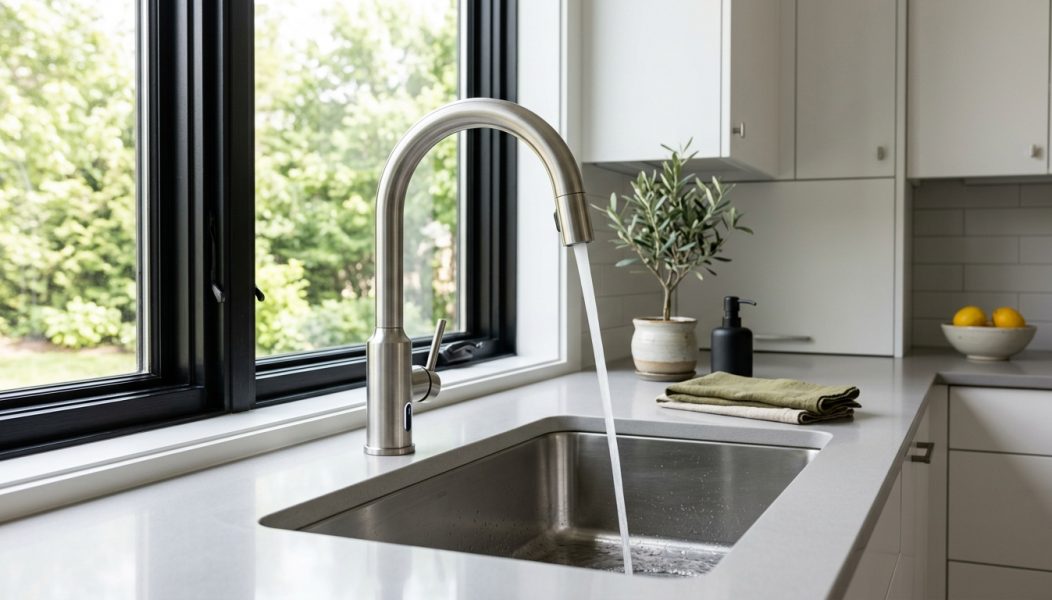
A smart touch faucet turns on and off when you tap anywhere on the faucet body or handle, whether with a finger, wrist, or forearm. This is especially useful when your hands are full or messy, since you don’t need to grip a handle to start or stop the water. Temperature and flow are typically still controlled with a standard handle, so touch faucets combine hands-free activation with the same manual precision you’d expect from a traditional faucet. Touch faucets run on batteries, a plug-in power adapter, or both, depending on the model. You can browse faucet options available to order through Banner Plumbing.
What is a Manual Faucet?
A manual faucet is a traditional, fully mechanical fixture operated by turning, lifting, or pulling a handle to control water flow and temperature. It doesn’t require batteries, electricity, or any sensor technology to function, which makes it simpler to install and use. Manual faucets remain the most common choice in kitchens and bathrooms and are available across a wide range of styles, finishes, and price points.
How Do Smart Touch and Manual Faucets Compare?
| Feature | Smart Touch | Manual |
|---|---|---|
| How It Activates | Tap anywhere on the faucet body or handle | Turn, lift, or pull a handle |
| Power Source | Batteries, plug-in adapter, or both | None required |
| Installation | Often benefits from professional installation | Straightforward standard installation |
| Upfront Cost | Typically higher due to sensor components | Typically lower |
| Reliability During a Power or Battery Outage | Depends on model; some retain manual handle function as a backup | Fully functional regardless of power or battery status |
| Best Suited For | Messy or full-hands moments, hands-free convenience | Simplicity and long-term mechanical reliability |
Depends on how you use the space: a busy kitchen where hands are often messy may benefit from a touch faucet’s convenience, while a bathroom or secondary kitchen may be well served by a manual faucet’s simplicity. A showroom visit is the best way to try both before deciding.
Is a Touch Faucet the Same as a Touchless Faucet?
No, and this is a common point of confusion. A touch faucet requires physical contact, such as tapping the body with your hand or wrist, to turn the water on or off. A touchless faucet uses a motion sensor and doesn’t require any contact at all; you simply move your hand near the spout. Both are different from a manual faucet, which relies entirely on a handle. If you’re comparing all three options, it’s worth clarifying which type you’re actually looking at, since touch and touchless faucets work differently even though both fall under the broader “smart faucet” category. Brands handle this differently, too. Delta’s Touch2O is tap-activated, while Pfister’s REACT faucets use a motion sensor, which is one of the key differences between Delta and Pfister faucets.
Which Faucet is Right for Your Kitchen or Bath?
The right choice depends on your household’s habits and priorities:
- Choose a smart touch faucet if you frequently have messy or full hands and want hands-free convenience without giving up manual temperature control.
- Choose a manual faucet if you prefer mechanical simplicity, want to avoid batteries or power dependency, or are outfitting a lower-traffic space.
- Consider your kitchen or bath’s specific use when deciding. A busy family kitchen and a guest bathroom often call for different priorities.
For homeowners who aren’t sure which fits their space, visiting our Buffalo Grove kitchen and bath showroom to try both faucet types in person is the most practical next step. If you’re also comparing specific faucet brands, our Delta vs. Kohler Faucets comparison is a helpful next read.
Frequently Asked Questions
- What is the difference between a smart touch faucet and a manual faucet?
A smart touch faucet turns on and off with a tap anywhere on the faucet body, while a manual faucet requires turning or lifting a handle. Touch faucets still use a handle for temperature and flow control.
- Do touch faucets require batteries or electricity?
Yes. Touch faucets need a power source, either batteries, a plug-in adapter, or both, depending on the model, to power the tap sensor.
- What happens to a touch faucet if the batteries die or the power goes out?
This depends on the model. Some touch faucets retain a manual handle function as a backup, while others rely entirely on the sensor to operate. It’s worth confirming this detail for a specific faucet before purchasing if backup function matters to you. Contact Banner Plumbing if you’d like help checking this for a specific model.
- Are touch faucets more expensive than manual faucets?
Touch faucets typically cost more upfront due to the sensor and electronic components involved, and installation may require professional help. Manual faucets are generally more affordable and simpler to install.
- Is a touch faucet the same as a touchless faucet?
No. A touch faucet requires physical contact to activate, while a touchless faucet uses a motion sensor and doesn’t require any contact at all.
- Are touch faucets reliable long-term?
Touch faucets involve more components than manual faucets, including a sensor and power source, which means there are more parts that could eventually need attention. Manual faucets are mechanically simpler, which some homeowners prioritize for long-term reliability.