Table of Contents
- Key Takeaways
- What is Cabinet Overlay?
- What is a Full Overlay Cabinet?
- What is a Partial Overlay Cabinet?
- How Do Full Overlay and Partial Overlay Cabinets Compare?
- How Much Upkeep Do Full Overlay and Partial Overlay Cabinets Need?
- Full Overlay vs. Inset Cabinets: What’s the Difference?
- Which Overlay is Right for Your Kitchen or Bath?
- Frequently Asked Questions
The difference between full overlay and partial overlay cabinets comes down to how much of the cabinet frame shows around each door and drawer front. Full overlay doors cover almost the entire frame, leaving only a thin reveal between doors. Partial overlay doors are smaller, leaving more of the frame visible. Get directions to the Buffalo Grove showroom to see both overlay styles side by side, or stop by to explore cabinet options in person with our team.
Key Takeaways
- Full overlay cabinets cover most of the frame, creating a cleaner, more streamlined look with minimal reveal between doors.
- Partial overlay cabinets show more of the frame, giving a more traditional, layered appearance.
- Full overlay is common on frameless cabinet construction; partial overlay is common on framed construction.
- Neither option is objectively better. The right choice depends on your kitchen or bath’s style, budget, and door alignment preferences.
What is Cabinet Overlay?
Cabinet overlay refers to how much a door or drawer front covers, or overlays, the cabinet frame beneath it. The amount of overlay affects both the look of the cabinetry and the small gap, called a reveal, that appears between adjacent doors and drawers. Overlay is a separate decision from cabinet construction style (framed vs. frameless), though the two are often paired in predictable ways. It’s also just one of several factors to weigh alongside cabinet styles and grades when planning a kitchen or bath remodel.
What is a Full Overlay Cabinet?
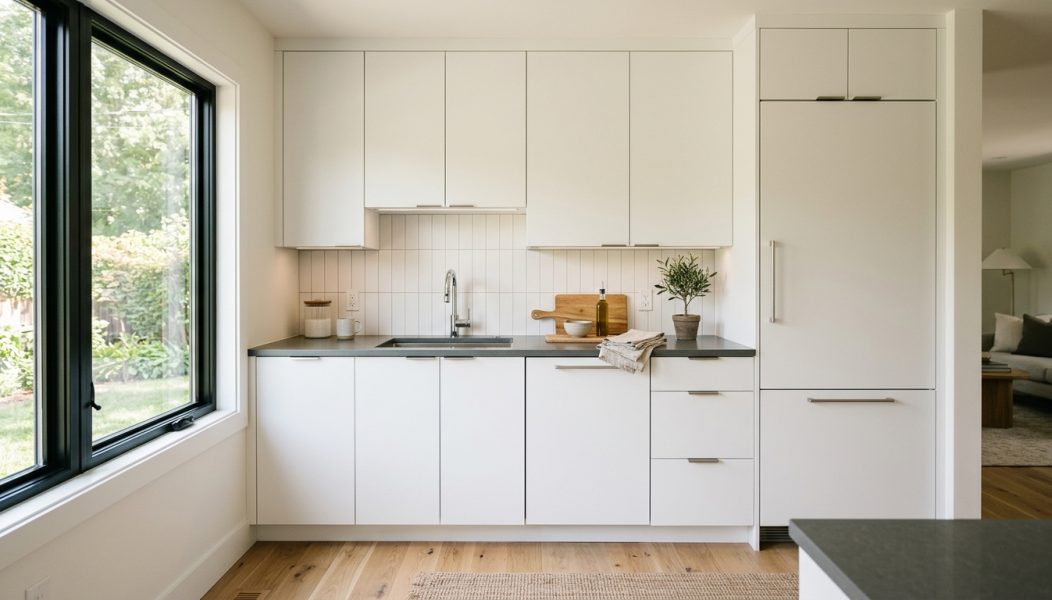
A full overlay cabinet has doors and drawer fronts sized to cover nearly the entire cabinet frame, leaving only a narrow reveal, often around 1/8 inch, between neighboring doors. This creates a clean, contemporary look with minimal visible frame. Full overlay is the standard approach on frameless cabinet boxes and is also available on many framed cabinet lines. You can browse kitchen cabinet options available to order through Banner Plumbing.
What is a Partial Overlay Cabinet?
A partial overlay cabinet, sometimes called a standard overlay cabinet, uses smaller doors and drawer fronts that cover only part of the frame. This leaves a wider reveal, typically 1 to 2 inches, and more visible wood framing between doors. Partial overlay is closely associated with traditional framed cabinet construction and tends to give kitchens and baths a more classic, layered appearance.
How Do Full Overlay and Partial Overlay Cabinets Compare?
| Feature | Full Overlay | Partial Overlay |
|---|---|---|
| Reveal Between Doors | Narrow, often around 1/8 inch | Wider, typically 1 to 2 inches |
| Visible Cabinet Frame | Minimal | More visible |
| Overall Look | Clean, streamlined, contemporary | Traditional, layered |
| Common Construction Pairing | Frameless (and many framed lines) | Framed |
| Hinge Requirements | Often requires specific hinge types to manage the tight reveal | More forgiving of standard hinge hardware |
| Door Alignment | Requires precise, consistent spacing | More tolerant of minor variation |
Depends on the kitchen: a modern remodel with clean lines often leans toward full overlay, while a traditional kitchen or bath may call for partial overlay’s classic look. A showroom visit is the most reliable way to compare both in person before deciding.
How Much Upkeep Do Full Overlay and Partial Overlay Cabinets Need?
Both overlay styles hold up well over the long term with proper care, but they ask for slightly different attention day to day. Full overlay cabinets have a narrow reveal, so consistent hinge adjustment matters more here; even small amounts of wood movement from humidity changes can make doors look uneven since there’s so little gap to absorb the shift. The upside is that the tight seams mean less dust and grime collects between doors compared to a wider reveal.
Partial overlay cabinets are more forgiving day to day. The wider reveal hides minor shifts in alignment, and the visible frame adds a bit of structural reinforcement around each opening. That wider gap does mean slightly more surface area to wipe down and keep dust-free.
In both cases, actual lifespan depends more on the cabinet box construction, materials, and hardware quality than on the overlay style itself. Choosing a well-built cabinet line and keeping hinges properly adjusted matters more for longevity than whether the doors are full or partial overlay.
Full Overlay vs. Inset Cabinets: What’s the Difference?
Full overlay and inset are often confused because both can appear on frameless-style boxes, but they’re different approaches. On a full overlay cabinet, the door sits in front of and covers the frame. On an inset cabinet, the door sits flush inside the frame opening, similar to a picture frame, exposing the full frame around it. Inset construction generally requires the most precise manufacturing of the three styles and is typically reserved for premium or custom cabinet lines.
Which Overlay is Right for Your Kitchen or Bath?
The right overlay style depends on the look you’re after and how the cabinets will be built:
- Choose full overlay if you want a clean, contemporary appearance with minimal visible framing.
- Choose partial overlay if you prefer a traditional look with more visible wood detail between doors.
- Inset construction is worth asking about if you want the most classic, furniture-like appearance. It’s generally found on premium or custom cabinet lines, so check with the showroom team on which lines and options are available to order.
For homeowners and designers who aren’t sure which fits their space, visiting the Buffalo Grove showroom to see sample doors in each overlay style side by side is the most practical next step.
Frequently Asked Questions
- What is the difference between full overlay and partial overlay cabinets?
Full overlay doors cover nearly the entire cabinet frame with a narrow reveal between doors, while partial overlay doors are smaller and leave more of the frame visible.
- What is a reveal on a cabinet door?
The reveal is the small gap between two adjacent cabinet doors or drawer fronts. Full overlay cabinets have a narrow reveal, while partial overlay cabinets have a wider one.
- Are full overlay cabinets more expensive than partial overlay?
Full overlay cabinets often require more precise manufacturing tolerances to keep reveals consistent, which can affect cost. Exact pricing depends on the cabinet line and finish, so it’s best to compare options at the showroom, view kitchen cabinet selections available to order, or contact Banner Plumbing for current pricing.
- Do full overlay cabinets need special hinges?
Many full overlay cabinets use hinges designed to manage the tight reveal between doors. The specific hinge type depends on the cabinet manufacturer and door style.
- What are common issues with full overlay cabinets?
Because the reveal between full overlay doors is narrow, inconsistent installation or humidity-related wood movement can make misalignment more noticeable than it would be on partial overlay cabinets. Proper installation and quality hardware help minimize this.
- Can full overlay and partial overlay cabinets be mixed in the same kitchen?
It’s possible, though most homeowners choose one overlay style throughout a kitchen or bath for a consistent look. A designer or showroom consultant can advise on whether mixing styles makes sense for a specific layout.
- Is full overlay the same as frameless cabinets?
No. Overlay refers to how much the door covers the frame, while frameless refers to the cabinet box construction itself. Full overlay is common on frameless boxes, but it also appears on some framed cabinet lines.