Table of Contents
- Framed vs. Frameless Cabinets: Quick Comparison
- Is a Frameless Cabinet the Same as a Face Frame Cabinet?
- What is the Difference Between Framed and Frameless Cabinets?
- What is a Frameless Cabinet?
- What is a Face Frame Cabinet?
- What is a Reveal in Cabinetry?
- Is Framed Better Than Frameless?
- Is Frameless Better Than Framed?
- Framed Cabinets: Pros and Considerations
- Frameless Cabinets: Pros and Considerations
- Framed vs. Frameless Cabinets: Overlay and Door Options
- Framed vs. Frameless Cabinets: Strength and Structural Support
- Framed vs. Frameless Cabinets: Installation and Hardware
- Best Uses for Framed vs. Frameless Cabinets
- What Should You Compare in Person Before Choosing Framed or Frameless Cabinets?
- Should You Choose Framed or Frameless Cabinets?
- Where Can You Compare Framed and Frameless Cabinets in Person?
- Framed vs. Frameless Cabinets FAQs
Framed and frameless cabinets are the two main types of cabinet construction in kitchen cabinetry, and homeowners, designers, and contractors planning a Chicagoland kitchen remodel often compare them before choosing a cabinet line. The difference isn’t about grade or price tier, like the choice between stock and semi-custom cabinets. It’s about how the cabinet box itself is built, and that construction method affects storage access, door overlay options, and overall style.
Framed cabinets are built with a face frame, a solid wood frame across the front of the cabinet box that the doors attach to. Frameless cabinets, sometimes called full-access or European-style cabinets, are built without that frame, so the doors attach directly to the sides of the box. Neither construction method is better for every kitchen. The right choice depends on the look you want, how much interior access matters to you, and which overlay and door styles you’re drawn to.
Planning a remodel? See framed and frameless cabinets in person to compare how each construction method looks and feels before deciding. Visit Banner Plumbing’s Buffalo Grove kitchen showroom for guidance, or get directions to the showroom.
Framed vs. Frameless Cabinets: Quick Comparison
| Category | Framed Cabinets | Frameless Cabinets |
|---|---|---|
| Construction | Solid wood face frame across the cabinet box front | No face frame; doors attach directly to the box sides |
| Also Known As | Face frame cabinets, traditional cabinets | Full-access cabinets, European-style cabinets |
| Overlay Options | Full overlay, partial (standard) overlay, or inset | Full overlay only |
| Storage Access | Slightly reduced by the frame and center stiles | Slightly more open due to no frame overhang |
| Structural Support | Frame reinforces the box and resists racking | Relies on a thicker box and panel construction |
| Style Association | Traditional, transitional | Modern, contemporary |
| Hardware | Longer screws anchor into the frame; any hinge style works | Shorter screws anchor into side panels; typically concealed European hinges |
Is a Frameless Cabinet the Same as a Face Frame Cabinet?
No. A frameless cabinet and a face frame (framed) cabinet are built differently. Framed cabinets have a face frame attached to the front of the cabinet box that the doors and drawers hinge to. Frameless cabinets have no face frame, so the doors attach directly to the cabinet box sides.
What is the Difference Between Framed and Frameless Cabinets?
The main difference between framed and frameless cabinets is the presence of a face frame. Framed cabinets, also called face frame cabinets, use a solid wood frame, typically about 1.5 inches wide, across the front of the cabinet box. This frame reinforces the box and gives the doors a mounting surface, and it’s the traditional method used in most American cabinet construction.
Frameless cabinets, also known as full-access or European-style cabinets, eliminate that frame entirely. The doors and drawer fronts attach directly to the sides of the cabinet box, so what you see when you look at an open frameless cabinet is the edge of the box itself, not a wood frame.
That single construction difference affects several other decisions: which overlay styles are available, how much interior storage space you get, how the cabinets are installed, and which design style the cabinets naturally lean toward.
What is a Frameless Cabinet?
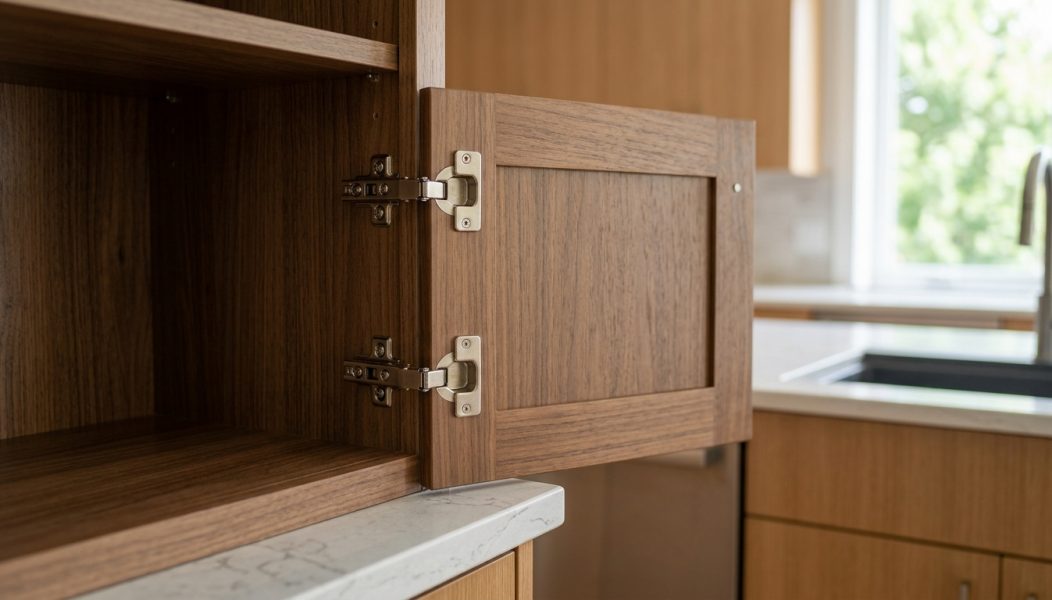
A frameless cabinet is a cabinet built without a face frame, so the door attaches directly to the side panels of the cabinet box. Frameless cabinets are also called full-access cabinets because removing the frame and center stiles opens up the full width of the cabinet interior. Frameless kitchen cabinets are closely associated with modern and contemporary kitchens, though frameless cabinets can be finished in a range of styles, including shaker-inspired doors.
What is a Face Frame Cabinet?
A face frame cabinet, also called a framed cabinet, is built with a solid wood frame attached to the front of the cabinet box. The frame consists of vertical stiles and horizontal rails, and the cabinet doors hinge to this frame rather than to the box itself. Face frame construction is the traditional standard in American cabinetry and supports all three door overlay types: full overlay, partial overlay, and inset.
What is a Reveal in Cabinetry?
A reveal is the amount of the face frame that remains visible around the cabinet door once it’s installed. With a full overlay door on a framed cabinet, a small reveal, typically around a quarter inch, is still visible around the frame. With an inset door, the entire face frame is visible since the door sits flush inside the frame opening. Frameless cabinets have essentially no reveal, since there’s no frame to show, which is part of what gives frameless construction its clean, seamless look.
Is Framed Better Than Frameless?
Framed cabinets may be a better fit if you want the widest range of door overlay options, including inset, or if you’re drawn to a traditional or transitional kitchen style. The face frame also reinforces the cabinet box and helps prevent racking, where doors and drawers can pull out of alignment over time.
Framed cabinets are not automatically the better choice for every kitchen. Frameless cabinets may still be the stronger direction if you want a cleaner, more modern look or slightly more usable interior storage space.
Is Frameless Better Than Framed?
Frameless cabinets may be a better fit if you want a modern, seamless look with minimal reveal around the doors, or if maximizing interior storage access matters to your layout. Because there’s no face frame or center stile in the way, frameless cabinets offer slightly more open access to the interior.
Frameless cabinets are not automatically the better choice for every kitchen. Framed cabinets may still be the stronger direction if you want inset or partial overlay doors, or a more traditional style.
Framed Cabinets: Pros and Considerations
Framed, or face frame, cabinets remain the traditional standard in American kitchen cabinetry and are often selected for their design flexibility and structural reinforcement.
Framed Cabinet Pros
- Supports all three overlay styles: full overlay, partial overlay, and inset
- Face frame reinforces the cabinet box and helps resist racking
- Longer screws anchor more deeply into the face frame during installation
- Works with any hinge style, including visible hinges for a traditional look
- Wide range of door styles across traditional, transitional, and modern designs
Framed Cabinet Considerations
- The face frame and center stiles can slightly reduce interior storage access
- Full overlay framed cabinets still show a small reveal of the face frame
- Alignment between the frame and door reveals should be reviewed carefully, especially with inset doors
Frameless Cabinets: Pros and Considerations
Frameless, or full-access, cabinets are the European-style construction method and are often selected for their clean look and open interior storage.
Frameless Cabinet Pros
- Full-access interior with no frame or center stile blocking the opening
- Clean, minimal-reveal look that suits modern and contemporary kitchens
- Slightly more usable storage space than a comparable framed cabinet
- Modern frameless cabinets built with quality materials are just as sturdy as framed construction
Frameless Cabinet Considerations
- Full overlay is the only true overlay option; partial overlay and inset are not standard without added trim
- Attaches to adjacent cabinets and walls through the side panels rather than a face frame, which affects installation
- Hinges are typically concealed European-style hinges mounted to the box sides rather than a frame
Framed vs. Frameless Cabinets: Overlay and Door Options
Overlay refers to how much of the cabinet’s front structure the door covers. Framed cabinets support all three types: full overlay, where the door covers most of the frame and leaves a small reveal; partial or standard overlay, where more of the frame is visible around each door; and inset, where the door sits flush inside the frame opening with the entire frame visible.
Frameless cabinets are full overlay only, since there’s no frame for a partial overlay or inset door to sit against. Some manufacturers can approximate an inset look on frameless cabinets by adding trim or paneling to the sides of the box, which is worth asking about if you’re drawn to both the frameless construction style and an inset appearance.
Shaker-style doors are available in both framed and frameless construction, so frameless shaker cabinets and framed shaker cabinets are both common choices, and the door style itself doesn’t require choosing one construction method over the other. Whether you’re comparing frameless cabinet doors or the door and frame combination used on framed kitchen cabinets, the construction method mainly affects the reveal, the overlay options, and the interior access, not which door styles are available.
Framed vs. Frameless Cabinets: Strength and Structural Support
Framed cabinets get additional structural support from the face frame, which reinforces the box and helps resist racking, the gradual misalignment of doors and drawers over time. This is one reason face frame construction has remained the traditional standard for so long.
Frameless cabinets don’t have a face frame to lean on, so manufacturers typically compensate with thicker box panels and more robust box construction overall. Older frameless cabinets had a reputation for being less sturdy than framed construction, but modern frameless cabinets built with quality materials are generally considered just as durable today.
Framed vs. Frameless Cabinets: Installation and Hardware
Framed and frameless cabinets attach to walls and to each other differently, which affects the hardware used. Framed cabinets are secured through the width of the face frame, which allows for longer screws anchored into solid wood. Frameless cabinets attach directly through the cabinet’s side panels, which generally calls for shorter screws sized to the panel thickness.
Hinges also differ in typical practice. Framed cabinets can use a wide range of hinge styles, including visible hinges for a more traditional look. Frameless cabinets typically use concealed European-style hinges mounted to the inside of the box, which supports the clean, seamless appearance the construction style is known for.
Best Uses for Framed vs. Frameless Cabinets
| Kitchen Goal | Better Starting Point | Why |
|---|---|---|
| Traditional or transitional kitchen style | Framed | Wide range of overlay and door style options, including inset |
| Modern or contemporary kitchen style | Frameless | Clean, minimal-reveal look with a seamless appearance |
| Maximizing interior cabinet storage | Frameless | No face frame or center stile blocking the opening |
| Inset door styling | Framed | Inset requires a face frame for the door to sit against |
| Whole-home cabinetry with mixed door styles | Framed | Supports the widest range of overlay types for flexibility |
| RTA or ready-to-assemble project | Depends | Both framed and frameless RTA options exist; fit depends on style preference |
What Should You Compare in Person Before Choosing Framed or Frameless Cabinets?
The difference between framed and frameless construction is often easier to see and feel in person than in a photo. During a showroom visit, it can be helpful to compare:
- Reveal and overlay: How much of the frame shows on a framed full overlay door compared to the nearly seamless look of a frameless door.
- Interior access: Reaching into a framed cabinet versus a frameless cabinet of the same size.
- Door and drawer alignment: How each construction method handles alignment over time, especially with heavier drawer fronts.
- Hinge style: Concealed European hinges versus more visible traditional hinges.
- Overall kitchen style: Whether your layout and finishes lean traditional, transitional, or modern.
Should You Choose Framed or Frameless Cabinets?
Choose framed cabinets if you want the widest range of overlay options, including inset, or if your kitchen’s style leans traditional or transitional. The face frame also adds structural reinforcement that many homeowners find reassuring for long-term use.
Choose frameless cabinets if you want a clean, modern look with minimal reveal, or if maximizing interior storage access is a priority in your layout. Frameless construction is closely associated with contemporary kitchen design, though it can support a range of door styles.
Neither construction method is universally better. The right choice depends on the style you want, how much you value maximum interior access, and which overlay and door options matter most to your project. If you’re also still deciding on cabinet grade and style more broadly, our guide to types of kitchen cabinets, styles, and grades covers that side of the decision in more depth.
Where Can You Compare Framed and Frameless Cabinets in Person?
You can compare framed and frameless cabinets in person at Banner Plumbing’s Buffalo Grove kitchen showroom. Seeing both construction methods side by side makes it easier to judge reveal, interior access, and overall style before committing to a cabinet line.
Banner Plumbing’s kitchen furniture selection includes cabinetry across both framed and frameless construction, so you can compare options in one place. If you’re just getting started on your kitchen remodel, our guide on how to estimate the cost of a kitchen remodel can help you think through budget alongside construction and style choices.
Visiting the showroom is especially useful if you are:
- Choosing cabinetry for a kitchen remodel
- Comparing traditional face frame construction against a modern frameless look
- Deciding between overlay styles, including inset
- Working with a designer, builder, or contractor on layout and storage planning
If you are deciding between framed and frameless cabinets, visit Banner Plumbing’s Buffalo Grove kitchen showroom to compare construction, overlay, and style in person. You can also get directions to the showroom, or contact Banner Plumbing with questions before your visit.
Framed vs. Frameless Cabinets FAQs
- Is a frameless cabinet the same as a face frame cabinet?
No. Face frame, or framed, cabinets are built with a solid wood frame across the front of the box that the doors attach to. Frameless cabinets have no face frame, so the doors attach directly to the box sides.
- What is the difference between framed and frameless cabinets?
The main difference is the presence of a face frame. Framed cabinets use a wood frame across the front of the box for the doors to attach to. Frameless cabinets attach doors directly to the box sides and rely on the box itself for structure.
- What is a frameless cabinet?
A frameless cabinet, also called a full-access cabinet, is built without a face frame, so the door attaches directly to the side panels of the cabinet box.
- What is a face frame cabinet?
A face frame cabinet, also called a framed cabinet, has a solid wood frame of stiles and rails attached to the front of the box, and the doors hinge to that frame.
- Are frameless cabinets more expensive?
Cost depends more on the manufacturer, materials, and finish than on construction method alone. Framed and frameless cabinets are both available across a range of price points.
- Are frameless cabinets better than framed cabinets?
Neither is better for every kitchen. Frameless cabinets are often chosen for a modern look and slightly more interior access. Framed cabinets are often chosen for their range of overlay options and traditional styling.
- Are frameless cabinets less sturdy than framed cabinets?
Older frameless cabinets had a reputation for being less sturdy, but modern frameless construction with quality box materials is generally considered just as durable as framed construction today.
- Are cabinet stiles structural?
Yes, in framed cabinets. The stiles are the vertical members of the face frame and help reinforce the cabinet box, along with the horizontal rails.
- How wide are cabinet face frames?
Face frames are typically around 1.5 inches wide, though this can vary slightly by manufacturer.
- What is a reveal in cabinetry?
A reveal is the portion of the face frame that remains visible around a cabinet door. Full overlay framed doors typically show a small reveal, inset doors show the full frame, and frameless cabinets show almost no reveal at all.
- Can frameless cabinets be inset?
Not in the traditional sense, since inset doors require a face frame to sit against. Some manufacturers can add trim or paneling to a frameless box to approximate an inset look, which is worth asking about if you want both the frameless construction and an inset appearance.
- Do frameless cabinets have less storage space?
Frameless cabinets typically have slightly more usable interior space than framed cabinets, since there’s no face frame or center stile narrowing the opening.
- Are RTA cabinets framed or frameless?
Ready-to-assemble (RTA) cabinets are available in both framed and frameless construction. RTA frameless cabinets are a common option for homeowners who want the modern, full-access look in a ready-to-assemble format, so the choice comes down to style and overlay preference rather than the RTA format itself.